Planning a multi day wilderness expedition requires more than just enthusiasm and a backpack. You’re likely here because you want clear, reliable guidance on how to prepare, navigate, and stay safe in remote terrain—without overlooking the small details that can make or break your experience. This article is designed to give you exactly that.
From cave trekking fundamentals and terrain analysis to survival skills and essential outdoor gear tips, we break down the core principles that help adventurers move confidently through challenging environments. Whether you’re exploring rugged backcountry routes or descending into unfamiliar cave systems, preparation and knowledge are your greatest assets.
Our insights are grounded in real-world outdoor experience, practical field strategies, and a deep understanding of navigation and wilderness safety. By the end of this guide, you’ll have a clear framework for planning, packing, and executing your expedition with greater confidence and awareness.
From Dream to Trailhead: Mastering Your First Remote Expedition
You’ve imagined it: mist lifting off alpine lakes, boots crunching gravel, no cell signal in sight. Then reality hits. Planning a multi day wilderness expedition can feel overwhelming—navigation fears, food planning, weather risks (and yes, the “what if I get lost?” spiral).
A Practical Framework for Getting There
Start with the basics:
- Route research: Study topographic maps (detailed elevation maps) and recent trail reports.
- Gear shakedown: Test equipment on shorter trips before committing.
- Skills practice: Learn compass navigation, water purification, and layered clothing systems.
Preparation replaces anxiety with capability. Plan deliberately, build skills gradually, and step onto the trail confident—not lucky.
The Blueprint: Strategic Planning and Terrain Analysis
Choosing Your Arena starts with brutal honesty about your skill level. A seasoned backpacker might crave isolation; a beginner may need marked trails and reliable water. Research seasonal climate patterns (NOAA data is a solid starting point) and confirm year-round water sources—streams on a spring map can vanish by late summer. Look for hazard reports: avalanche zones, flash-flood canyons, wildfire history. A remote trip should feel adventurous, not like an audition for a survival reality show.
Mastering the Map
Digital tools like CalTopo and Gaia GPS allow you to layer satellite imagery, slope angle shading, and public land boundaries. Plot elevation gain carefully—1,000 feet per mile is a grind, not a stroll. Identify logical campsites near water but above flood zones. Most importantly, design bailout routes. A bailout route is a pre-planned exit if weather, injury, or fatigue hits. On a multi day wilderness expedition, knowing your “escape hatch” is SMART, not cowardly.
Terrain intelligence comes from contour lines. Close lines mean steep terrain; wide spacing signals gentler slopes. V-shaped contours pointing uphill indicate valleys; U-shapes often mark ridges. Saddles—low points between peaks—can offer efficient crossings (or brutal wind tunnels). Study them before your boots hit dirt.
Permits and regulations matter. Fire bans, wildlife protocols, and bear canister requirements protect both you and the ecosystem (the National Park Service reports thousands of human-wildlife incidents annually). What’s next? Check gear weight, emergency comms, and weather windows. PLAN SMARTER NOW so you’re not improvising later.
Your Lifeline: Assembling the Essential Gear Kit

The Big Three: Weight vs. Durability
Your Big Three—backpack, shelter, and sleep system—will define your comfort (or misery).
Backpack: Ultralight (under 2.5 lbs) vs. traditional framed (3–5 lbs). Ultralight saves energy on long treks, but framed packs carry heavier loads more comfortably. If you’re hauling technical gear, structure wins.
Shelter: Tent vs. tarp vs. hammock. Tents offer full protection and bug control; tarps are lighter but require skill (and good weather judgment); hammocks shine in forested terrain but struggle above treeline. For unpredictable climates—like those discussed in seasonal challenges in untouched natural landscapes—a lightweight tent often balances risk and comfort.
Sleep System: Down bags are lighter and warmer by weight; synthetic bags perform better when wet. Pair either with an insulated sleeping pad (R-value measures thermal resistance). Skipping the pad? That’s rookie-level regret by 2 a.m.
The Layering System: Adapt or Suffer
The three-layer principle works because it separates function:
- Base layer: Wicks moisture (merino vs. synthetic—merino resists odor, synthetic dries faster).
- Mid layer: Insulates (fleece vs. down—fleece handles moisture better).
- Shell: Blocks wind/rain (softshell breathes; hardshell fully waterproof).
Think of it as climate control you wear.
Navigation Toolkit: Digital vs. Analog
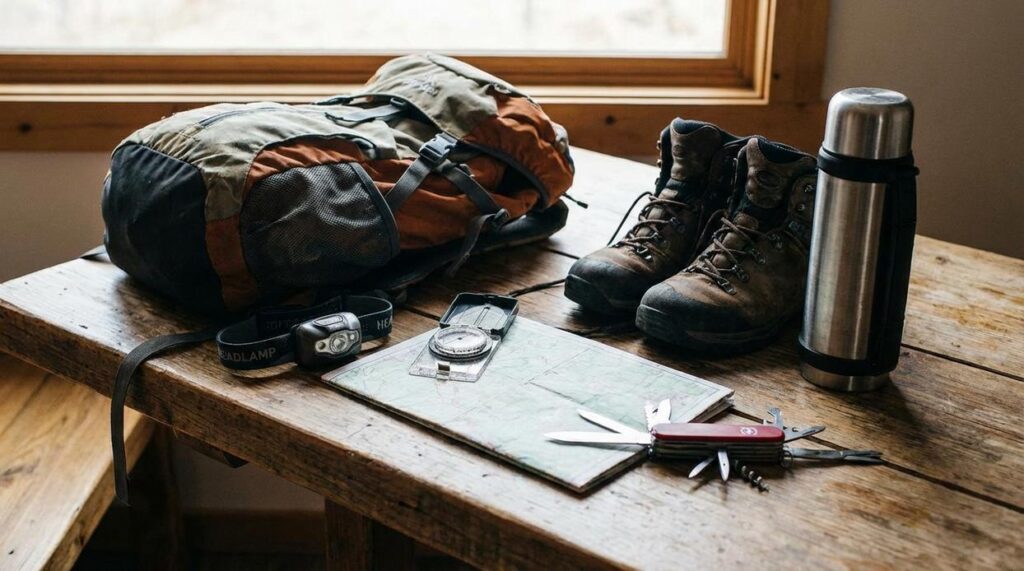
GPS is convenient. Batteries die. A baseplate compass aligns with a topographic map to determine bearing and position. Together, they’re your fail-safe on a multi day wilderness expedition.
The Ten Essentials (Modernized)
- Navigation
- Illumination
- Sun Protection
- First-Aid
- Knife/Repair Kit
- Fire
- Shelter
- Extra Food
- Extra Water + purification
- Extra Clothes
Some argue minimalism builds resilience. True—to a point. But preparedness isn’t overpacking; it’s intelligent redundancy (the difference between adventure and a rescue report).
Stay Found
When you step off a marked trail, navigation becomes more than following footprints. A bearing is simply the direction from your location to another point, measured in degrees on a compass. To take one, align the compass with your map, rotate the housing until north matches the map’s north, then follow the indicated degree line in the field. Similarly, orienting a map means turning it so the terrain around you matches the symbols on paper. Ridges, valleys, and saddles—low points between peaks—act as “handrails” that confirm position.
Next, water. Filters physically remove bacteria and protozoa, chemical treatments neutralize pathogens through reactions, and UV devices disrupt DNA so microbes cannot reproduce (think sci-fi, but practical). In arid terrain, look for green vegetation corridors; in alpine zones, check below snowfields.
Equally important, wildlife etiquette prevents conflict. Store food in bear canisters or hang bear bags at least ten feet high and four feet from trunks. If you encounter wildlife, stay calm, make yourself appear larger, and back away slowly.
Finally, if lost during a multi day wilderness expedition, use S.T.O.P.: Stop, Think, Observe, Plan. Then signal with bright fabric, whistles, or three fires in a triangle to attract rescuers quickly.
Life on the Trail: Daily Rhythms and Best Practices
First, efficient camp setup starts with durable ground—flat, well-drained, 200 feet from water. This protects ecosystems and your sleep (no one likes a midnight puddle surprise). Lay shelter, then kitchen, keeping cooking downwind. Think less reality TV chaos, more calm “Survivor” competence.
Next, fuel wisely. Plan high-calorie, lightweight meals—oats, nuts, dehydrated dinners—and ration by day on a multi day wilderness expedition. Repackage to cut waste.
Finally, practice seven Leave No Trace principles: plan ahead, travel on durable surfaces, dispose of waste properly, leave what you find, minimize fire impact, respect wildlife.
Embracing the Wild with Confidence
You now hold a comprehensive toolkit for planning a safe, rewarding extended outdoor adventure. The fears that once whispered about getting lost, underprepared, or overwhelmed shrink when you rely on planning, smart gear choices, and practiced skills.
Proper research, route mapping, weather checks, and conditioning are practical antidotes to uncertainty. Test equipment locally. Build navigation habits. Pack redundancies for essentials (water filtration, light, first aid).
A multi day wilderness expedition stops feeling intimidating and starts feeling purposeful.
Take the first step today: pick a destination on a map and begin researching permits and terrain conditions.
Ready for Your Next Step Underground
You set out to understand what it really takes to prepare for a multi day wilderness expedition inside complex cave systems—and now you have the foundation to do it right. From terrain analysis and navigation planning to survival skills and gear selection, you’ve seen how preparation turns uncertainty into confidence.
The truth is, most adventurers underestimate how quickly conditions can shift underground. Poor route planning, inadequate lighting, or the wrong equipment can turn an unforgettable journey into a dangerous situation. That risk is real—but it’s avoidable when you know what to look for and how to prepare.
Now it’s time to act. Start refining your route plans, upgrade the gear that won’t hold up in extended cave conditions, and sharpen your survival and navigation skills before you descend. Don’t leave your safety to guesswork.
If you’re serious about mastering cave trekking and planning your next multi day wilderness expedition, explore our expert guides and proven field-tested strategies trusted by outdoor explorers who demand reliability. Equip yourself properly, train intentionally, and take the next step with confidence today.
 Janice Martinezelous has opinions about cave navigation and terrain analysis. Informed ones, backed by real experience — but opinions nonetheless, and they doesn't try to disguise them as neutral observation. They thinks a lot of what gets written about Cave Navigation and Terrain Analysis, Cave Trekking Basics and Survival Skills, Horizon Headlines is either too cautious to be useful or too confident to be credible, and they's work tends to sit deliberately in the space between those two failure modes.
Reading Janice's pieces, you get the sense of someone who has thought about this stuff seriously and arrived at actual conclusions — not just collected a range of perspectives and declined to pick one. That can be uncomfortable when they lands on something you disagree with. It's also why the writing is worth engaging with. Janice isn't interested in telling people what they want to hear. They is interested in telling them what they actually thinks, with enough reasoning behind it that you can push back if you want to. That kind of intellectual honesty is rarer than it should be.
What Janice is best at is the moment when a familiar topic reveals something unexpected — when the conventional wisdom turns out to be slightly off, or when a small shift in framing changes everything. They finds those moments consistently, which is why they's work tends to generate real discussion rather than just passive agreement.
Janice Martinezelous has opinions about cave navigation and terrain analysis. Informed ones, backed by real experience — but opinions nonetheless, and they doesn't try to disguise them as neutral observation. They thinks a lot of what gets written about Cave Navigation and Terrain Analysis, Cave Trekking Basics and Survival Skills, Horizon Headlines is either too cautious to be useful or too confident to be credible, and they's work tends to sit deliberately in the space between those two failure modes.
Reading Janice's pieces, you get the sense of someone who has thought about this stuff seriously and arrived at actual conclusions — not just collected a range of perspectives and declined to pick one. That can be uncomfortable when they lands on something you disagree with. It's also why the writing is worth engaging with. Janice isn't interested in telling people what they want to hear. They is interested in telling them what they actually thinks, with enough reasoning behind it that you can push back if you want to. That kind of intellectual honesty is rarer than it should be.
What Janice is best at is the moment when a familiar topic reveals something unexpected — when the conventional wisdom turns out to be slightly off, or when a small shift in framing changes everything. They finds those moments consistently, which is why they's work tends to generate real discussion rather than just passive agreement.