If you’re searching for reliable guidance on remote wilderness exploration, you likely want more than inspiration—you want practical knowledge that keeps you prepared, confident, and safe. Venturing beyond marked trails and familiar terrain demands a clear understanding of navigation, survival skills, terrain analysis, and the right outdoor gear. Without accurate information, small mistakes in isolated environments can quickly become serious risks.
This article is designed to give you exactly what you’re looking for: clear, experience-backed insights into cave trekking basics, reading Horizon headlines for environmental awareness, and mastering essential backcountry techniques. We draw on field-tested survival strategies, proven navigation methods, and up-to-date outdoor best practices to ensure the guidance you’re reading is both actionable and dependable.
Whether you’re planning your first expedition or refining advanced skills, you’ll find practical steps, safety considerations, and expert-informed tips to help you explore remote landscapes with confidence and control.
Some landscapes don’t whisper—they summon. Stand at the edge of a wind-carved canyon or beneath a sky unpolluted by city glow, and you feel it: a magnetic pull toward something older, wilder, truer. Yet true wilderness gives nothing cheaply. It rewards courage and curiosity, but only when matched with preparation, skill, and respect. Otherwise, it humbles fast.
So what’s in it for you? Growth that boardrooms and classrooms rarely deliver. Through remote wilderness exploration, you build resilience, sharpen judgment, and rediscover self-reliance. In sections ahead, you’ll gain mindset shifts, skills, and gear knowledge needed to venture out confidently—and return transformed.
Beyond the Trailhead: The Purpose of Deep Exploration
There’s a reason people leave paved paths behind. Recreational pursuits like trekking, packrafting, and mountaineering in isolated terrain test strength, stamina, and judgment in ways a gym never could. Hauling a 40-pound pack up a scree slope or navigating a glacial river by inflatable raft demands FULL COMMITMENT. The features of these activities—variable weather, uneven terrain, limited supplies—aren’t inconveniences; they’re the point. They build endurance, sharpen awareness, and deliver a hard-earned sense of accomplishment (the kind no medal can replicate).
In educational terms, wild landscapes function as living laboratories. A limestone cave reveals karst geology in action; alpine meadows showcase plant succession; river corridors illustrate erosion and sediment transport. Textbooks explain these processes, but seeing them firsthand during remote wilderness exploration transforms abstract theory into tangible understanding.
Psychologically, unplugging from constant notifications recalibrates attention. Without digital crutches, you rely on map, compass, and instinct. Problem-solving becomes immediate and real. • Greater resilience
• Sharper decision-making
Some argue such trips are risky and unnecessary. Fair. But managed preparation—route planning, terrain analysis, proper gear—turns risk into growth. Pro tip: always rehearse navigation skills before departure. The reward? Clarity, confidence, and a renewed connection to the natural world.
The Trinity of Survival: Navigation, Terrain, and Self-Reliance
Survival isn’t luck. It’s SKILL. And three pillars matter most: navigation, terrain analysis, and core self-reliance.
1. Mastering Navigation
Navigation means knowing where you are, where you’re going, and how to get back. A topographic map shows elevation through contour lines—tight lines mean steep terrain; wide spacing means gradual slope. Triangulation (pinpointing your location using two or more visible landmarks and compass bearings) is NON-NEGOTIABLE. GPS is helpful, but batteries die (usually at the worst possible moment).
Recommendation: Carry a physical map and compass every time. Practice plotting bearings before you need them.
Pro tip: Store your map in a waterproof sleeve—paper turns useless fast.
2. Terrain Analysis
Terrain analysis means reading the land before it reads you. Scan ahead for river crossings (look for wide, shallow bends), avalanche chutes (treeless corridors on steep slopes), and unstable ground like scree fields.
In remote wilderness exploration, small misjudgments compound quickly. Think of it like a chessboard—plan three moves ahead.
| Hazard | What to Look For | Smart Move |
|---|---|---|
| River Crossing | Fast current, narrow banks |
Cross at widest shallow point |
| Avalanche Chute | Steep, smooth snow corridors | Detour to ridgeline |
| Loose Scree | Shifting small rocks | Step on larger embedded rocks |
3. Core Survival Skills
Remember the Rule of Threes: 3 minutes without air, 3 hours without shelter, 3 days without water, 3 weeks without food (Red Cross). Prioritize accordingly.
Build a debris shelter with branches and thick leaf cover. Boil water for one minute (CDC). Signal with three blasts or fires—universal distress code.
Survival isn’t dramatic like the movies (sorry, Bear Grylls fans). It’s disciplined preparation.
Packing for Self-Sufficiency: Your Backcountry Lifeline
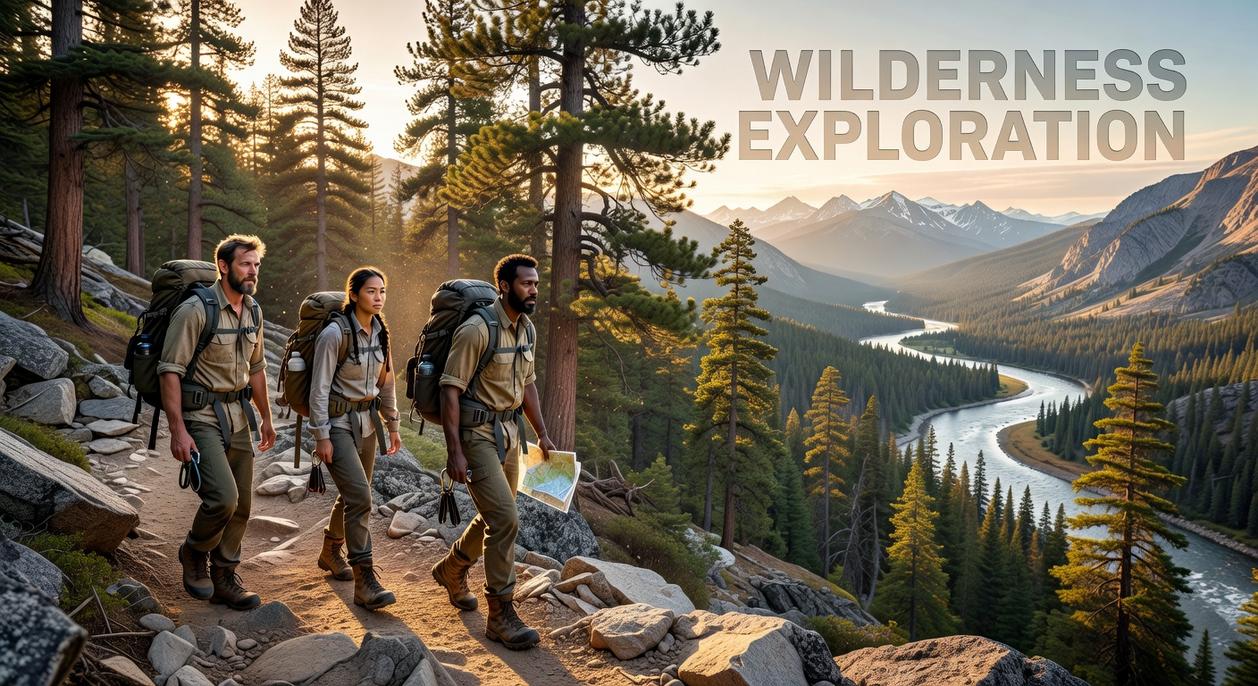
I learned about the Ten Essentials the hard way—halfway through a whiteout when my “quick afternoon hike” turned into an unplanned bivouac. Since then, I never step into remote wilderness exploration without them.
The modern Ten Essentials form your survival baseline: navigation (map, compass, GPS), headlamp (with extra batteries), sun protection (hat, sunscreen, sunglasses), first aid kit, knife or multi-tool, fire starter, emergency shelter, extra food, extra water, and extra clothes. These aren’t just items; they’re redundancies—backup systems when plans fail (and sometimes they do).
However, some argue that carrying all ten is overkill for short trips. I used to agree. Yet conditions change fast, and what feels excessive at the trailhead feels essential at dusk. Pro tip: review your kit each season so it evolves with your skill level.
Beyond the basics, tailor gear to terrain and objective. Climbing? Add a harness and helmet. Paddling? Pack a dry bag and PFD. Winter travel demands insulated layers and traction devices.
That said, weight matters. The art of packing light means choosing multi-use items—a buff that’s sun guard and bandage, a trekking pole that supports a tarp shelter. The lighter your pack, the farther—and safer—you travel.
For added preparation, review wildlife awareness strategies for backcountry travelers.
Descending into Darkness: The Unique Challenge of Cave Exploration
Caving—also known as spelunking—is often called the final frontier of remote wilderness exploration. However, unlike hiking a mountain trail, the subterranean world removes the sky, the horizon, and even natural light. Above ground, you navigate by landmarks and weather patterns; below ground, you navigate by touch, rope systems, and memory (and yes, it’s as disorienting as it sounds).
The dangers differ sharply. A forest hiker worries about storms; a caver worries about sudden flooding in narrow passages. On a cliff face, a climber manages exposure; in a cave, tight squeezes and vertical shafts demand rappelling and ascending skills in total darkness. In other words, it’s navigation without visual comfort.
Because of this, gear shifts from optional to essential. Standard hiking boots won’t cut it. Instead, helmets, multiple independent light sources, and abrasion-resistant clothing become non-negotiable. Preparation underground isn’t just smart—it’s survival.
Your first step into a wider world begins with intention. Successful remote wilderness exploration is not luck or bravado; it’s a deliberate practice rooted in knowledge, preparation, and respect for the land beneath your boots. When you can read a map like a story, prioritize water, shelter, and warmth, and choose gear that feels balanced on your shoulders, the forest shifts. The wind sounds less like a warning and more like a whisper. Start small. Hike local trails. Smell the pine, feel the grit of stone, listen to your breath. Build skill, then go farther. Step forward with steady confidence.
Take Your Next Step Into the Wild
You came here to strengthen your knowledge of cave trekking, survival skills, navigation, terrain analysis, and the gear that keeps you safe in unpredictable environments. Now you have a clearer understanding of what it takes to move confidently through challenging landscapes and prepare for true remote wilderness exploration.
The reality is that the wild doesn’t forgive hesitation or poor preparation. A wrong turn, unreliable gear, or a lack of terrain awareness can quickly turn adventure into danger. That’s why mastering the fundamentals—and applying them consistently—matters so much.
Now it’s time to act. Put what you’ve learned into practice. Review your gear. Sharpen your navigation skills. Study your terrain before you set foot on it. And if you want trusted, field-tested insights that outdoor explorers rely on, dive deeper into our expert guides and practical breakdowns.
Don’t leave your next expedition to chance. Equip yourself with proven strategies, prepare with confidence, and step into the wild ready for whatever it brings.